
 Written by
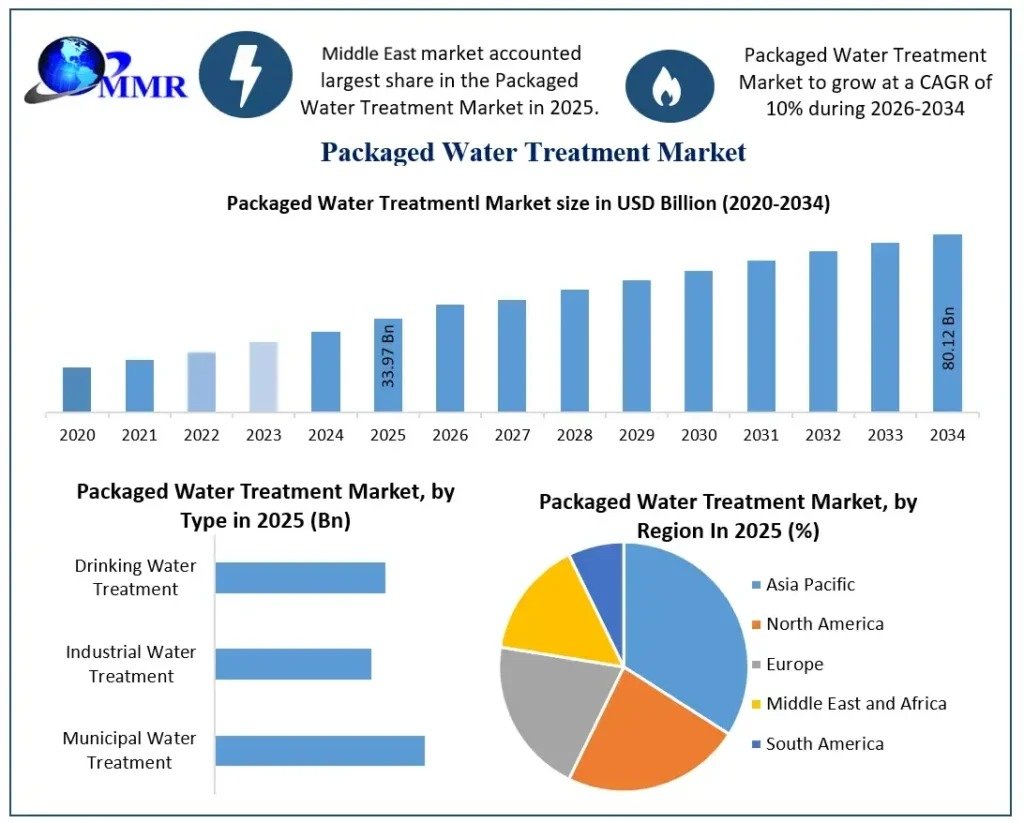
Packaged Water Treatment Market to Reach USD 80.12 Billion by 2034, Driven by Rising Water Demand and Advanced Treatment Technologies
Market Estimation, Growth Drivers, and Opportunities
The Packaged Water Treatment Market was valued at USD 33.97 billion in 2025 and is projected to reach nearly USD 80.12 billion by 2034, expanding at a compound annual growth rate (CAGR) of 10% during the forecast period from 2026 to 2034. Packaged water treatment systems provide compact, pre-engineered solutions for treating drinking water and wastewater, offering efficient installation, flexible capacity, and reduced infrastructure requirements across municipal, industrial, commercial, and remote applications.
Increasing population, rapid urbanization, industrial expansion, and growing concerns about water contamination are among the primary factors driving market growth. Municipal authorities and industrial operators are increasingly seeking dependable treatment solutions to improve water quality, meet environmental requirements, and reduce the pressure on conventional treatment infrastructure.
Technological advancements in reverse osmosis, membrane bioreactors, moving bed biofilm reactors, and automated treatment processes are creating additional opportunities. Modular systems can be deployed in locations where constructing large conventional plants is expensive or impractical. Rising interest in wastewater recycling, water reuse, decentralized infrastructure, and energy-efficient purification is expected to strengthen demand throughout the forecast period.
United States Market Trends and Investment in 2025
The United States remains an important market for packaged water treatment solutions because of aging water infrastructure, increasing attention to emerging contaminants, industrial water requirements, and the need for reliable drinking water supplies. In 2025, federal water infrastructure programs continued to support investment in drinking water improvements, wastewater management, lead service line replacement, and projects addressing per- and polyfluoroalkyl substances (PFAS). Funding through the Drinking Water State Revolving Fund and infrastructure legislation creates opportunities for treatment equipment providers, engineering companies, and technology developers. Utilities and industrial facilities are also showing interest in compact filtration, membrane-based purification, remote monitoring, and automated operations. These developments support demand for scalable packaged systems that can improve treatment performance while helping operators manage installation costs, maintenance requirements, and increasingly complex water quality challenges.
Get a Sample Insight Report Now : https://www.maximizemarketresearch.com/request-sample/86619/
Market Segmentation: Leading Segments
By Application: Municipal wastewater treatment represents a major application segment, supported by population growth, expanding urban settlements, and increasing requirements for wastewater collection and treatment. Municipal authorities require scalable systems to improve wastewater processing, protect water resources, and accommodate growing community needs. Drinking water treatment also remains an important application because of rising demand for safe and reliable water supplies.
By Treatment Type: Extended aeration, moving bed biofilm reactors (MBBR), reverse osmosis, membrane bioreactors (MBR), and sequential batch reactors (SBR) are important technologies in the market. These solutions address different treatment requirements, from biological wastewater processing to advanced purification. Reverse osmosis and membrane-based technologies offer opportunities where high-quality treated water and water reuse are priorities.
Competitive Analysis: Leading Industry Participants
Competition is shaped by treatment efficiency, system reliability, engineering expertise, operating costs, product customization, and service capabilities. The following companies are prominent participants identified in the market study. Their inclusion does not establish a verified ranking by individual market share.
- Veolia Water Technologies: Veolia offers water and wastewater treatment technologies, including modular solutions for municipal and industrial customers. Its expertise in water reuse, resource recovery, and advanced purification positions the company to benefit from demand for integrated treatment systems and improved operational efficiency.
- GE Water & Process Technologies: The business has established expertise in industrial water treatment, filtration, and membrane technologies. Advanced purification and process optimization capabilities are relevant to manufacturers seeking dependable water quality and efficient industrial operations.
- RWL Water: RWL Water specializes in customized water and wastewater treatment solutions for industrial, municipal, and community applications. Its project-oriented approach supports demand for adaptable systems designed for different water conditions and operating environments.
- WesTech Engineering Inc.: WesTech provides water and wastewater treatment equipment and process technologies. Continued innovation in filtration, clarification, and biological treatment can help customers improve treatment performance and optimize plant operations.
- Smith & Loveless Inc.: Smith & Loveless develops packaged pumping and wastewater treatment systems for municipal and commercial applications. Compact equipment designs and integrated treatment solutions support installations where space, reliability, and simplified maintenance are important considerations.
Across the competitive landscape, investment in automation, membrane performance, modular engineering, digital monitoring, and resource-efficient operations represents an important avenue for product development. Specific company investment amounts and 2025 product announcements require individual verification and are not assumed here.
Regional Analysis
United States: Market opportunities are supported by infrastructure modernization, drinking water quality requirements, and federal and state funding programs. PFAS treatment, wastewater upgrades, and industrial water reuse are important areas of investment.
United Kingdom: Water quality regulation, wastewater infrastructure improvements, and growing emphasis on environmental protection encourage utilities and industrial operators to consider efficient, adaptable treatment technologies.
Germany: Strong environmental standards, advanced manufacturing, and industrial water efficiency requirements support demand for reliable wastewater treatment, filtration, and water recycling systems.
France: Water resource management, municipal wastewater treatment, and industrial sustainability initiatives create opportunities for packaged treatment technologies that support efficient operations and water reuse.
Japan: Limited space in densely developed areas, advanced industrial requirements, and interest in water efficiency favor compact, automated treatment solutions with dependable performance.
China: Urbanization, industrial development, wastewater management priorities, and continuing efforts to improve water quality support opportunities for modular treatment systems and advanced purification technologies.
Country-specific market shares are not stated because comparable figures are not established in the supplied market information.
Key Players
- Veolia Water Technologies
- GE Water & Process Technologies
- RWL Water
- WesTech Engineering Inc.
- Smith & Loveless Inc.
- Napier-Reid Ltd.
- CST Wastewater Solutions Inc.
- WPL International
- Enviroquip
- Corix Water Systems
Why This Market Matters Now
Water scarcity, population growth, industrial expansion, and increasing environmental expectations are making efficient water treatment a strategic priority. Packaged systems offer a practical approach to improving access to treated water without relying exclusively on large, conventional infrastructure projects. Their modular design can support phased capacity expansion, remote installations, emergency requirements, and industrial water reuse.
As governments, utilities, and businesses prioritize water security and infrastructure resilience, manufacturers that combine efficient treatment technologies with dependable service, automation, and lower operating requirements may be well positioned to capture emerging opportunities. The projected expansion of the market highlights the growing importance of decentralized water infrastructure in supporting sustainable economic development.