Written by
Supply Chain Finance Market to Reach USD 144.76 Billion by 2032, Driven by Digitalization and Increasing Demand for Working Capital Solutions
Market Estimation, Growth Drivers, and Opportunities
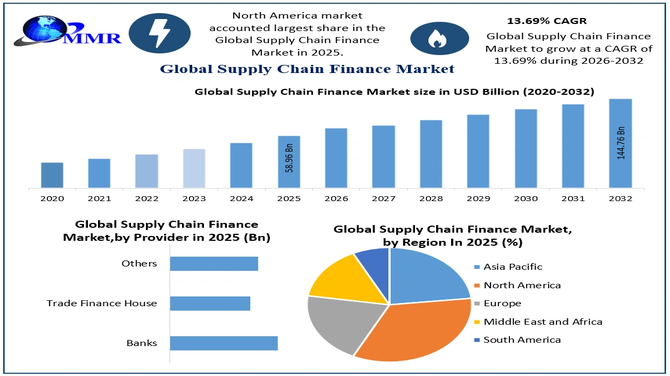
The global Supply Chain Finance Market was valued at approximately USD 58.96 billion in 2025 and is anticipated to reach USD 144.76 billion by 2032, expanding at a CAGR of 13.69% during the forecast period of 2026–2032. Supply chain finance encompasses financial solutions designed to improve working capital management, enhance cash flow, and strengthen financial relationships between buyers and suppliers. These arrangements allow buyers to optimize payment terms while enabling suppliers to access early payments at competitive financing rates through banks and financial institutions.
The growing emphasis on efficient working capital management is a major factor accelerating market growth. Organizations operating across manufacturing, retail, automotive, healthcare, and logistics sectors are increasingly adopting supply chain finance solutions to improve cash flow, minimize financing costs, and ensure uninterrupted business operations. Furthermore, the expansion of international trade and increasingly interconnected supply networks are creating demand for flexible financing arrangements. Small and medium-sized enterprises are also turning toward digital financing platforms to address cash flow shortages, overcome funding limitations, and access financial resources more efficiently.
Technological innovation is further opening new growth avenues for the market. The adoption of artificial intelligence, machine learning, blockchain, cloud-based platforms, and advanced analytics is enhancing invoice validation, fraud prevention, credit evaluation, and financial transaction transparency. Digital financing solutions are enabling financial institutions to streamline processing activities, reduce administrative expenses, and improve service delivery. Additionally, the growing adoption of sustainable supply chain finance, dynamic discounting, and digital receivables financing is creating opportunities for market participants to diversify their offerings. Nevertheless, regulatory complexities, challenges associated with supplier onboarding, and concerns regarding data security remain important factors that companies must address to ensure sustainable market development.
To know the most attractive segments, click here for a free sample of the report: https://www.maximizemarketresearch.com/market-report/supply-chain-finance-market/168082/
United States Market Trends and Investments
The United States represents a mature and technologically advanced market for supply chain finance, supported by established banking infrastructure, extensive commercial trade networks, and increasing demand for digital working capital solutions. In 2024, financial institutions and fintech companies focused on developing integrated financing platforms, improving supplier liquidity, and expanding access to alternative funding sources. GSCF introduced its Working Capital as a Service (WCaaS) solution in May 2024 by combining technology-enabled financing operations with funding partner capabilities to provide integrated working capital management. C2FO introduced SCF Propel in January 2024, enabling large enterprises to modernize existing supply chain finance programs and expand financing access to suppliers through its technology and funding network. Citi also continued investing in digital trade finance platforms, automation, and technology modernization to improve corporate banking services. These developments reflect increasing investments in cloud-based financing infrastructure, automated payment processing, and digital supplier financing. The growing focus on financial flexibility and liquidity management is expected to support further adoption of supply chain finance solutions across the United States.
Market Segmentation Analysis
By Provider: Banks
The banks segment accounted for the largest share of the global supply chain finance market, representing approximately 85% of the market in 2021, and is expected to maintain its leading position throughout the forecast period. Banks dominate the segment because of their established financial infrastructure, extensive corporate relationships, international banking networks, and ability to provide competitive financing solutions. Their strong credit assessment capabilities and access to large funding resources enable buyers and suppliers to manage working capital more efficiently. Additionally, banks are increasingly integrating digital platforms, automated invoice processing, and advanced analytics into their financing services to improve transaction speed and transparency.
By Application: Domestic
The domestic segment held the largest market share in 2025, accounting for approximately one-quarter of the global supply chain finance market. Its dominance is supported by increasing domestic trade activities, growing manufacturing operations, and rising demand for working capital solutions within national supply chains. Businesses are increasingly using domestic supply chain finance arrangements to improve supplier relationships, maintain liquidity, and streamline payment cycles. The expansion of domestic consumption in emerging economies, particularly in manufacturing-intensive countries, is further supporting segment development.
Competitive Analysis
The global supply chain finance market is highly competitive, with established banks, financial technology providers, and enterprise software companies focusing on digital innovation, financing accessibility, and strategic partnerships. The following five companies are among the major players identified in the market report.
1. Citi: Citi maintains a strong market position through its international banking network and corporate trade finance capabilities. In 2024, the company continued investing in digital supply chain financing platforms, electronic trade loans, and automated financial services. Its strategy emphasizes improving transaction transparency, strengthening banking partnerships, and simplifying cross-border financing operations. These investments support efficient working capital management for multinational businesses.
2. DBS Bank: DBS is strengthening its supply chain finance business through digital banking infrastructure, automated financing processes, and SME-focused financial solutions. In July 2024, DBS Bank India partnered with Receivables Exchange of India Limited (RXIL) to introduce a pre-shipment financing solution on the TReDS platform. The initiative enables small businesses to obtain financing before delivering goods, improving liquidity throughout the supply chain. Its continued focus on digital financing and alternative lending data creates opportunities for broader SME participation.
3. PrimeRevenue: PrimeRevenue focuses on technology-driven supply chain finance, accounts payable automation, and working capital optimization. In 2024, the company emphasized improvements to its supplier payment portal, including automated financial reporting, invoice tracking, document management, and enhanced audit capabilities. Its integrated technology platform also supports supplier onboarding and connections with multiple funding partners, improving financing accessibility across international supply chains.
4. C2FO: C2FO is expanding its digital working capital solutions through product innovation and strategic financing partnerships. In January 2024, the company introduced SCF Propel, a solution that enables enterprises to modernize existing supply chain finance programs without disrupting ongoing operations. In October 2024, C2FO also partnered with the International Finance Corporation (IFC) to develop a web-based working capital platform for micro, small, and medium-sized enterprises across Africa. These initiatives demonstrate its focus on expanding financing accessibility and improving supplier liquidity through digital technology.
5. Taulia: Taulia, part of SAP, is investing in digital working capital management, supplier financing, and sustainable finance solutions. In February 2024, the company collaborated with IFC to develop sustainable supply chain finance programs for SMEs in emerging markets. In October 2024, Taulia also partnered with Saudi Aramco and the Saudi Industrial Development Fund to establish a supply chain financing program aimed at improving supplier liquidity. These partnerships demonstrate the growing importance of technology-enabled and sustainability-linked financing solutions.
Regional Analysis
United States: The United States is an important contributor to the North American supply chain finance market, supported by its advanced banking infrastructure, developed financial services industry, and extensive corporate supply chains. Increasing investments in fintech platforms, digital trade finance, and automated working capital management are encouraging adoption. The country’s established financial regulatory framework, including banking supervision by the Federal Reserve and other regulatory authorities, supports structured financing operations. Demand from manufacturing, retail, automotive, and logistics companies further contributes to market development.
United Kingdom: The UK represents an established European market, driven by its international financial services industry, developed banking network, and extensive import-export activities. Government initiatives such as the Prompt Payment Code encourage timely payments and improved supplier relationships. Additionally, the UK’s focus on digital trade documentation and financial technology innovation is creating opportunities for automated invoice financing and supplier payment solutions.
Germany: Germany offers significant opportunities due to its strong manufacturing industry, export-oriented economy, and extensive network of small and medium-sized suppliers. The country’s digitalization initiatives and financial technology ecosystem are supporting the adoption of automated financing platforms. Furthermore, European Union regulations concerning payment practices, corporate sustainability reporting, and financial transparency are encouraging businesses to strengthen supply chain management and financing processes.
France: France is experiencing increasing adoption of supply chain finance solutions through its developed banking industry, international trade activities, and established manufacturing sector. Government initiatives supporting SME financing and digital transformation are improving access to financial services. Additionally, the European Union’s sustainability framework is encouraging businesses to introduce ESG-linked financing programs that reward suppliers for improving environmental and operational performance.
Japan: Japan represents an important Asian market, supported by its advanced manufacturing ecosystem, strong automotive industry, and extensive supplier networks. The government’s Society 5.0 initiative promotes digital transformation and technological integration across industries. Increasing adoption of digital banking, automated financial services, and electronic invoicing is creating opportunities for supply chain finance platforms. The need to strengthen SME liquidity and improve supplier relationships is further supporting market development.
China: China is a significant market for supply chain finance due to its extensive manufacturing base, large export industry, and expanding digital financial ecosystem. Government initiatives supporting digital finance, SME financing, and supply chain modernization are encouraging businesses to adopt technology-driven financial solutions. The growing use of blockchain, artificial intelligence, and electronic invoice management is improving financing transparency and operational efficiency. Increasing domestic consumption and manufacturing activity are also supporting demand for supplier financing solutions.
To know the most attractive segments, click here for a free sample of the report: https://www.maximizemarketresearch.com/request-sample/168082/
Conclusion
The global supply chain finance market is expected to experience strong growth as businesses increasingly prioritize liquidity management, working capital optimization, and financial stability across supplier networks. The expansion of international trade, increasing SME financing requirements, and adoption of digital financial platforms will remain important growth drivers. In particular, artificial intelligence, blockchain-based transaction management, automated invoice verification, and cloud-based financing solutions offer significant opportunities for market participants. Sustainable supply chain finance and alternative funding partnerships are also expected to create new avenues for industry development. Companies investing in secure digital platforms, faster supplier onboarding, transparent financing processes, and accessible SME solutions are likely to strengthen their competitive positions. Overall, technological innovation combined with increasing demand for efficient working capital management will play a crucial role in shaping the future of the global supply chain finance market.
About Us
Maximize Market Research publishes sector forecasts, competitive analysis, and consulting insight for teams evaluating demand, competition, pricing, and growth strategy across high-value industries.
MAXIMIZE MARKET RESEARCH PVT. LTD.
2nd Floor, Navale IT Park Phase 3
Pune Banglore Highway, Narhe
Pune, Maharashtra 411041, India
+91 9607365656