Written by
Battery Energy Storage System Market to Reach USD 103.71 Billion by 2034, Driven by Renewable Energy Integration and Rising Electricity Demand
The global Battery Energy Storage System (BESS) Market is experiencing rapid growth as governments, utilities, and industrial organizations increasingly invest in reliable electricity storage infrastructure. Battery energy storage systems play a critical role in storing electricity generated from renewable sources and supplying power during periods of high demand or limited generation. The growing adoption of solar and wind energy, increasing electricity consumption, grid modernization, and the global transition toward clean energy are creating significant opportunities for the industry. Furthermore, advancements in lithium-ion batteries, battery management systems, energy optimization software, and thermal management technologies are improving storage efficiency and supporting large-scale deployment.
To know the most attractive segments, click here for a free sample of the report: https://www.maximizemarketresearch.com/market-report/battery-energy-storage-system-market/2753/
1. Battery Energy Storage System Market Estimation, Growth Drivers and Opportunities
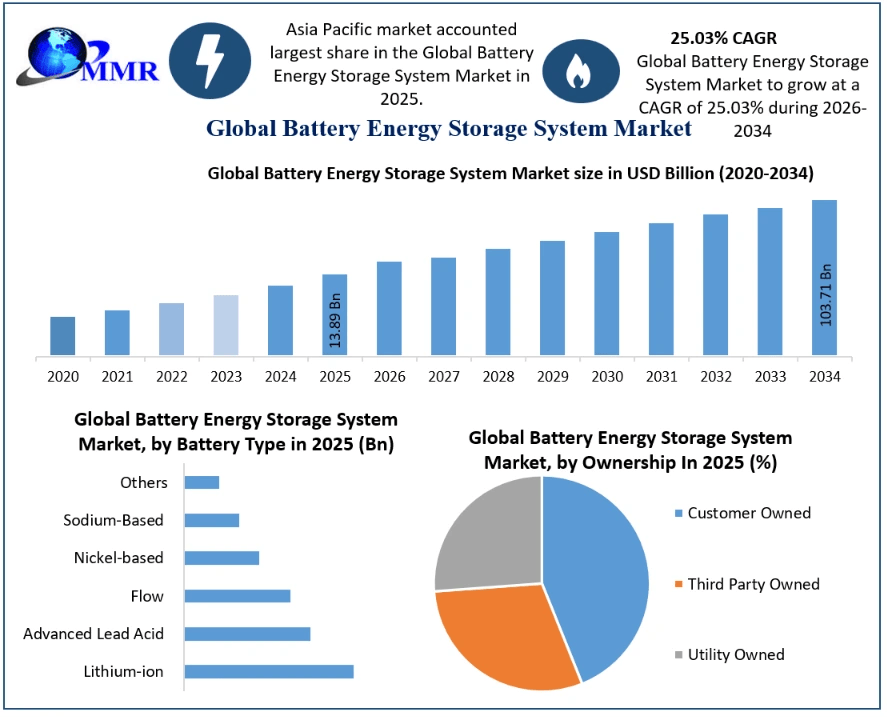
According to Maximize Market Research, the global Battery Energy Storage System Market was valued at USD 13.89 billion in 2025 and is projected to reach approximately USD 103.71 billion by 2034, registering a compound annual growth rate (CAGR) of 25.03% during 2026–2034.
The increasing integration of renewable energy sources is one of the primary factors driving market expansion. Solar and wind power generation are intermittent, creating challenges for electricity grid operators. Battery energy storage systems help overcome these challenges by storing surplus electricity and releasing it when renewable generation declines or electricity demand increases. This capability improves grid stability, reduces energy wastage, and supports the transition toward cleaner power generation.
Growing electricity consumption across residential, commercial, and industrial sectors is another important growth driver. The expansion of data centers, electric vehicle charging infrastructure, manufacturing facilities, and digital services is increasing the requirement for reliable electricity supplies. Utilities are investing in large-scale battery storage installations to manage peak demand, regulate grid frequency, and improve power distribution efficiency.
Government incentives and clean energy policies are further accelerating market adoption. Financial support for renewable energy projects, tax credits, energy storage procurement programs, and grid modernization initiatives are encouraging public and private investments. Technological advancements in lithium iron phosphate (LFP) batteries, advanced battery management systems, and energy management software are also improving operational safety, performance, and lifecycle economics.
The market presents substantial opportunities through the development of long-duration energy storage technologies, including flow batteries, sodium-ion batteries, and advanced lead-acid systems. Commercial and industrial facilities can benefit from battery storage through peak shaving, load shifting, backup power, and energy arbitrage. Additionally, artificial intelligence-based energy management, second-life electric vehicle batteries, and battery recycling technologies are creating new opportunities for manufacturers and service providers.
2. United States Battery Energy Storage System Market: Latest Trends and Investments in 2024
The United States battery energy storage system market experienced significant investment activity in 2024, supported by renewable energy expansion, grid modernization, and federal clean energy incentives. On May 23, 2024, Ørsted announced a USD 680 million tax equity financing agreement with JPMorgan for a solar and storage portfolio in Texas and Arizona. The portfolio included the 300 MW Eleven Mile Solar Center in Arizona, featuring a 300 MW/1,200 MWh battery storage system. In May 2024, New York City Economic Development Corporation also advanced a 100 MW battery storage project in Astoria, Queens, to strengthen electricity reliability. Additionally, the U.S. Department of Energy opened its 93,000-square-foot Grid Storage Launchpad at Pacific Northwest National Laboratory in August 2024 to support research, testing, and validation of next-generation battery technologies. Federal investment incentives under the Inflation Reduction Act, including standalone energy storage investment tax credits, further encouraged project development and domestic manufacturing. These developments demonstrate growing opportunities for utility-scale storage, advanced battery research, and renewable energy integration.
3. Battery Energy Storage System Market Segmentation: Largest Market Share
By Battery Type: The lithium-ion battery segment dominated the global battery energy storage system market, accounting for approximately 53.5% of revenue share in 2025. Its leadership is attributed to high energy density, longer operating life, declining manufacturing costs, and established supply chains. Lithium iron phosphate (LFP) and nickel manganese cobalt (NMC) batteries are widely used in utility-scale storage, commercial facilities, residential backup systems, and renewable energy installations. Continuous improvements in battery safety, thermal management, and charging efficiency are further supporting segment growth.
By End User: The utilities segment held the largest market position in the global market. Electric utilities increasingly deploy battery storage systems to regulate grid frequency, maintain voltage stability, manage peak electricity demand, and integrate renewable energy generation. Growing investments in grid-scale installations and electricity infrastructure modernization are supporting the segment’s dominance.
By Region: Asia Pacific accounted for approximately 44.5% of global market revenue in 2025, supported by large-scale battery manufacturing, renewable energy expansion, and government-backed energy storage initiatives.
4. Battery Energy Storage System Market Competitive Analysis
The global market is highly competitive, with leading manufacturers investing in battery chemistry, manufacturing capacity, safety systems, and integrated storage technologies. Five prominent companies from the Maximize Market Research report’s key-player list are Tesla, BYD, CATL, LG Energy Solution, and Samsung SDI.
1. Tesla Inc.: Tesla is a leading participant in the battery storage industry through its Megapack and Powerwall product portfolios. In 2024, the company continued expanding manufacturing capabilities at its Lathrop, California, Megafactory, which has an annual production capacity of approximately 40 GWh. Tesla also broke ground on a USD 203.94 million Megapack manufacturing facility in Shanghai in May 2024. The factory was designed to manufacture large-scale energy storage systems, strengthening Tesla’s international production capabilities and supporting utility-scale storage demand.
2. BYD Company Ltd.: BYD is strengthening its competitive position through its Blade Battery technology and integrated energy storage solutions. In April 2024, the company introduced its next-generation MC Cube-T energy storage system with a capacity of 6.432 MWh. The system incorporates high-capacity blade batteries and Cell-to-System technology, improving energy density and reducing installation space requirements. In June 2024, BYD also announced that its BatteryBox residential storage product had surpassed one million installations worldwide. These developments demonstrate its focus on technological innovation, product scalability, and international market expansion.
3. CATL: Contemporary Amperex Technology Co. Limited (CATL) is investing in high-performance lithium-ion batteries and large-scale energy storage solutions. In April 2024, the company launched its TENER energy storage system, offering 6.25 MWh capacity in a standard 20-foot container. CATL reported that its advanced battery technology could achieve zero capacity and power degradation during the first five years of operation. The system uses advanced solid-electrolyte-interphase and self-assembling electrolyte technologies to improve battery performance and safety. This innovation is expected to strengthen utility-scale storage adoption.
4. LG Energy Solution: LG Energy Solution is expanding its battery manufacturing infrastructure and strengthening its energy storage portfolio. In April 2024, the company provided an update on its USD 5.5 billion Arizona battery manufacturing complex, which includes plans for 16 GWh of annual LFP pouch-type battery production for energy storage applications. The investment is designed to strengthen North American manufacturing capabilities and meet increasing demand for locally produced batteries. LG Energy Solution is also developing standalone energy storage projects and renewable energy integration solutions.
5. Samsung SDI: Samsung SDI is focusing on high-capacity battery systems, advanced safety technologies, and next-generation battery chemistry. In June 2024, the company introduced its Samsung Battery Box 1.5, a containerized energy storage system offering 5.26 MWh capacity with an enhanced direct-injection system designed to improve fire safety. The company also outlined a dual-chemistry strategy involving NCA and LFP batteries for utility-scale storage applications. In September 2024, it showcased its latest energy storage products in North America, including LFP battery solutions and high-output batteries for data center backup systems.
5. Battery Energy Storage System Market Regional Analysis
United States: The United States is a major market for battery energy storage systems, supported by renewable energy investments, electricity grid modernization, and increasing demand for reliable power. The Inflation Reduction Act provides standalone energy storage investment tax credits, encouraging utility-scale and residential battery installations. In addition, the Department of Energy supports advanced battery research and domestic manufacturing through research grants and funding programs. Growing electricity requirements from data centers, electric vehicle charging networks, and industrial facilities are creating further investment opportunities.
United Kingdom: The UK market is expanding due to renewable energy integration, electricity grid flexibility requirements, and government support for long-duration energy storage. In October 2024, the government confirmed its intention to introduce a cap-and-floor revenue mechanism for long-duration electricity storage projects, with Ofgem serving as the regulatory delivery body. This initiative is expected to improve investment certainty and encourage private-sector participation in large-scale battery storage infrastructure.
Germany: Germany represents an important European market because of its energy transition strategy and increasing renewable electricity generation. The country’s growing solar and wind capacity is creating demand for battery storage systems to manage intermittent electricity generation and stabilize the grid. Government initiatives supporting renewable energy integration, energy storage development, and grid modernization are encouraging investments in residential, commercial, and utility-scale battery installations.
France: France offers considerable opportunities through its renewable energy expansion and electricity system modernization initiatives. In August 2024, the government launched a Decarbonized Flexibility tender to encourage investments in flexible electricity resources, including energy storage. The country’s energy transition strategy and growing demand for grid balancing solutions are creating opportunities for battery manufacturers, project developers, and energy management technology providers.
Japan: Japan is an emerging growth market supported by government initiatives to strengthen domestic battery manufacturing and improve electricity grid flexibility. In September 2024, the Ministry of Economy, Trade and Industry approved 12 battery supply-chain investment plans worth approximately JPY 1 trillion, with government subsidies of up to JPY 350 billion. The government is also supporting grid-scale battery installations to increase renewable energy utilization and improve energy security.
China: China is one of the most important markets for battery energy storage systems because of its large battery manufacturing industry, expanding renewable energy capacity, and government support for energy storage infrastructure. The country recorded approximately 73.76 GW of installed new-type energy storage capacity by the end of 2024, according to official figures reported in 2025. Its strong domestic battery supply chain, large-scale solar and wind installations, and investments in advanced storage technologies are supporting market expansion.
6. Conclusion
The global battery energy storage system market is positioned for substantial growth as renewable energy adoption, electricity consumption, and grid modernization accelerate worldwide. In my view, the most significant growth opportunity lies in developing cost-effective, safe, and high-capacity battery storage technologies that can support large-scale renewable energy integration.
Manufacturers should prioritize investments in lithium iron phosphate batteries, sodium-ion technology, flow batteries, advanced thermal management, and AI-powered battery management systems. Additionally, increasing demand from data centers, electric vehicle charging infrastructure, and industrial facilities will create new opportunities for utility-scale and behind-the-meter storage solutions.
Government incentives, domestic battery manufacturing investments, and improvements in recycling infrastructure will further strengthen market development. Companies that focus on product safety, longer battery lifecycles, efficient energy management, and competitive manufacturing costs are likely to gain a stronger position in the global industry. Overall, battery energy storage systems will remain an essential component of the transition toward a reliable, flexible, and sustainable electricity infrastructure.
To know the most attractive segments, click here for a free sample of the report: https://www.maximizemarketresearch.com/request-sample/2753/
About us
Maximize Market Research publishes sector forecasts, competitive analysis, and consulting insight for teams evaluating demand, competition, pricing, and growth strategy across high-value industries.
MAXIMIZE MARKET RESEARCH PVT. LTD.
2nd Floor, Navale IT Park Phase 3
Pune Banglore Highway, Narhe
Pune, Maharashtra 411041, India
+91 9607365656
sales@maximizemarketresearch.com