
 Written by
 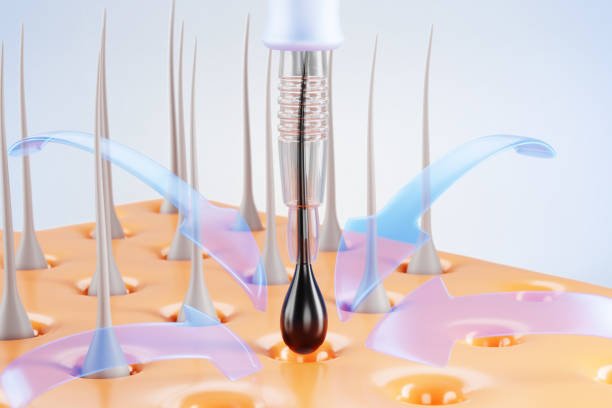 Hairline restoration is not simply a matter of putting more follicles into an empty area. DHI Direct Hair Implant in Dubai can provide controlled placement of individual follicular units when a patient needs additional frontal density and has sufficient donor hair.
The visual result depends on how grafts are distributed, not only on how many are implanted. Hair caliber, follicular-unit composition, existing native hair, scalp contrast, and growth direction all affect perceived coverage.
How DHI Direct Hair Implant in Dubai Creates Visual Density
Density is a three-dimensional concept.
Two patients can receive a similar number of grafts but have different results because their hair shafts have different thicknesses and their follicular units contain different numbers of hairs.
Hair Caliber and Coverage
Thicker hair shafts generally provide greater visual coverage than very fine strands.
This does not mean that fine-haired patients cannot achieve improvement. It means their treatment plan needs to work within the natural characteristics of their hair.
Follicular-Unit Distribution
The frontal edge often requires finer units.
Behind this transition, larger follicular units may provide additional density when appropriate. This gradual change helps the restored hairline avoid appearing overly dense at the very front.
DHI Direct Hair Implant in Dubai and the Existing Hairline
A common mistake is to look only at the areas where the scalp is visible.
Existing native hairs also need to be considered.
If the patient still has significant hair in the recipient area, graft placement must work around those follicles. This becomes particularly important when the hair is miniaturizing but has not yet disappeared.
Avoiding an Artificial Density Line
A transplanted area should not look like one section of the scalp suddenly contains a different type of hair.
The transition should be gradual.
Changes in follicle size, spacing, angle, and density can help integrate the restoration with the surrounding hair.
DHI Direct Hair Implant in Dubai Versus Other Techniques
| Feature | DHI | FUE | FUT |
|---|---|---|---|
| Individual follicular-unit harvesting | Yes | Yes | No |
| Direct implantation method | Commonly used | Not essential | Not essential |
| Frontal density planning | Yes | Yes | Yes |
| Hair direction control | Important | Important | Important |
| Donor-area limitation | Yes | Yes | Yes |
| Linear scar | No | No | Usually present |
| Natural result depends on planning | Yes | Yes | Yes |
The technique should be selected in relation to the patient’s anatomy rather than treated as a universal solution for every pattern of hair loss.
Planning Hairline Density in Dubai
Dubai patients often evaluate their hair under very different conditions.
Strong daylight can expose scalp visibility. Office lighting can emphasize the crown or frontal region. Humidity can change how hair sits, while wet hair can make density appear lower.
Why Photographs Can Be Misleading
A photograph captures one angle under one lighting condition.
A clinician needs to examine the scalp directly and assess hair characteristics from multiple perspectives.
This distinction is important when patients bring online photographs and ask for the same density. Different donor characteristics and hair calibers can make direct comparisons unreliable.
Clinical Execution of DHI Direct Hair Implant in Dubai
The procedure begins with donor assessment and recipient planning.
The clinician identifies suitable follicular units and determines where additional density is most likely to create a balanced visual improvement.
After extraction, the grafts are prepared for implantation.
Direct implantation then allows each selected unit to be positioned according to the planned angle and direction.
For patients researching this approach, the DHI Direct Hair Implant service in Dubai explains the treatment category in more detail.
Patient Questions About Density
“Can you make my hairline extremely dense?”
The amount of achievable density is limited by donor availability and the characteristics of the patient’s hair.
“Why not place all the grafts at the front?”
A concentrated frontal allocation can leave other areas under-resourced and may not be appropriate if future hair loss is expected.
“Does higher density always look more natural?”
Not necessarily. Natural appearance depends on appropriate density gradients, graft selection, direction, and integration with native hair.
Recovery and Density Development
The implanted hair does not immediately represent the final result.
The scalp first enters a healing phase. Temporary shedding can occur, followed by progressive new growth.
As the hair grows, the visual density changes.
Patients should therefore avoid comparing an early post-treatment photograph with a mature result. The biological growth cycle needs time to develop.
Managing Hair Restoration Around Dubai’s Climate
Recovery planning should account for local conditions.
Direct sunlight may need to be avoided during the early healing period. Heat, sweating, exercise, and swimming may also need temporary restrictions.
Patients should follow the individualized instructions provided by their treating clinician because recovery recommendations can differ according to the procedure and the patient.
Density Should Be Planned, Not Maximized
The objective of hair restoration is not to create the highest possible graft concentration.
A well-designed result should distribute the available donor follicles intelligently and maintain a natural relationship between the hairline, mid-scalp, crown, and existing native hair.
DHI provides a precise implantation method, but the treatment plan remains the foundation of the result.
Tajmeels Clinic focuses on individualized hair restoration planning based on donor characteristics, hair density, facial proportions, and long-term expectations.