
 Written by
 Every manufacturer shares a common goal: produce more high-quality products, faster, and at a lower cost. Achieving this ideal requires more than just running machines harder; it requires a deep, nuanced understanding of production dynamics. This is the domain of Production Performance Analytics . Unlike simple production counts, performance analytics delves into the why behind the numbers. Why did the line slow down at 2:00 PM? Why is Station 4 producing 5% more scrap than Station 2? Answering these questions requires a powerful technological partner: Manufacturing Intelligence Software . This software serves as the platform to visualize, analyze, and act upon the insights generated by performance analytics, turning raw data into a roadmap for operational excellence.
Together, these two tools form a powerful flywheel for continuous improvement. Production Performance Analytics identifies the opportunities for improvement—pinpointing bottlenecks, tracking cycle time variations, and correlating quality defects to specific production parameters. Manufacturing Intelligence Software then democratizes this information, delivering it in easy-to-understand dashboards and alerts to the exact people who can take action. This creates a culture where every shift, every team, and every machine is constantly being optimized based on hard data, not tribal knowledge or guesswork.
All of the metrics above are useless if they remain trapped in a database or a spreadsheet. Manufacturing Intelligence Software acts as the visualization and collaboration layer. It presents this complex data through intuitive interfaces designed for different user roles. A plant manager might see a high-level OEE scorecard across all lines, while a shift supervisor sees a real-time bottleneck alert on a specific conveyor, and a quality engineer sees a detailed statistical process control (SPC) chart for a critical dimension.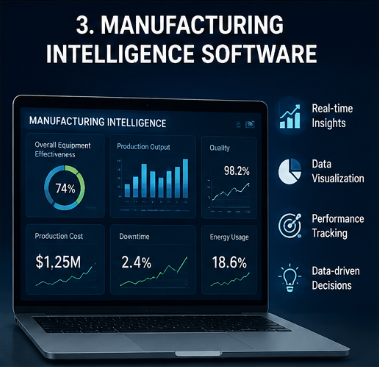 The true power emerges when performance analytics triggers automated actions. For example, the system detects that the cycle time on a filling machine has exceeded its upper control limit for three consecutive units. The Manufacturing Intelligence Software can automatically: 1. Send an alert to the technician’s wearable device. 2. Log the event in the production history. 3. Pause the downstream packaging line to prevent processing bad units. 4. Create a digital work order for a line inspection.
This speed of response turns a potential defect or downtime event into a minor, quickly corrected variance.
The path to world-class manufacturing is paved with data. By abandoning intuition-based management and embracing a rigorous system of Manufacturing Intelligence Software , manufacturers can operationalize the insights from Production Performance Analytics . This powerful combination illuminates the hidden constraints within a factory, providing the clarity needed to systematically eliminate waste, optimize flow, and drive sustainable, long-term growth