Written by
 As demand for botanical ingredients continues to grow across the US nutraceutical, functional beverage, and food sectors, sourcing teams are dealing with a familiar problem: two suppliers can offer seemingly comparable ginger ingredients, yet the materials may perform differently once they enter commercial production.
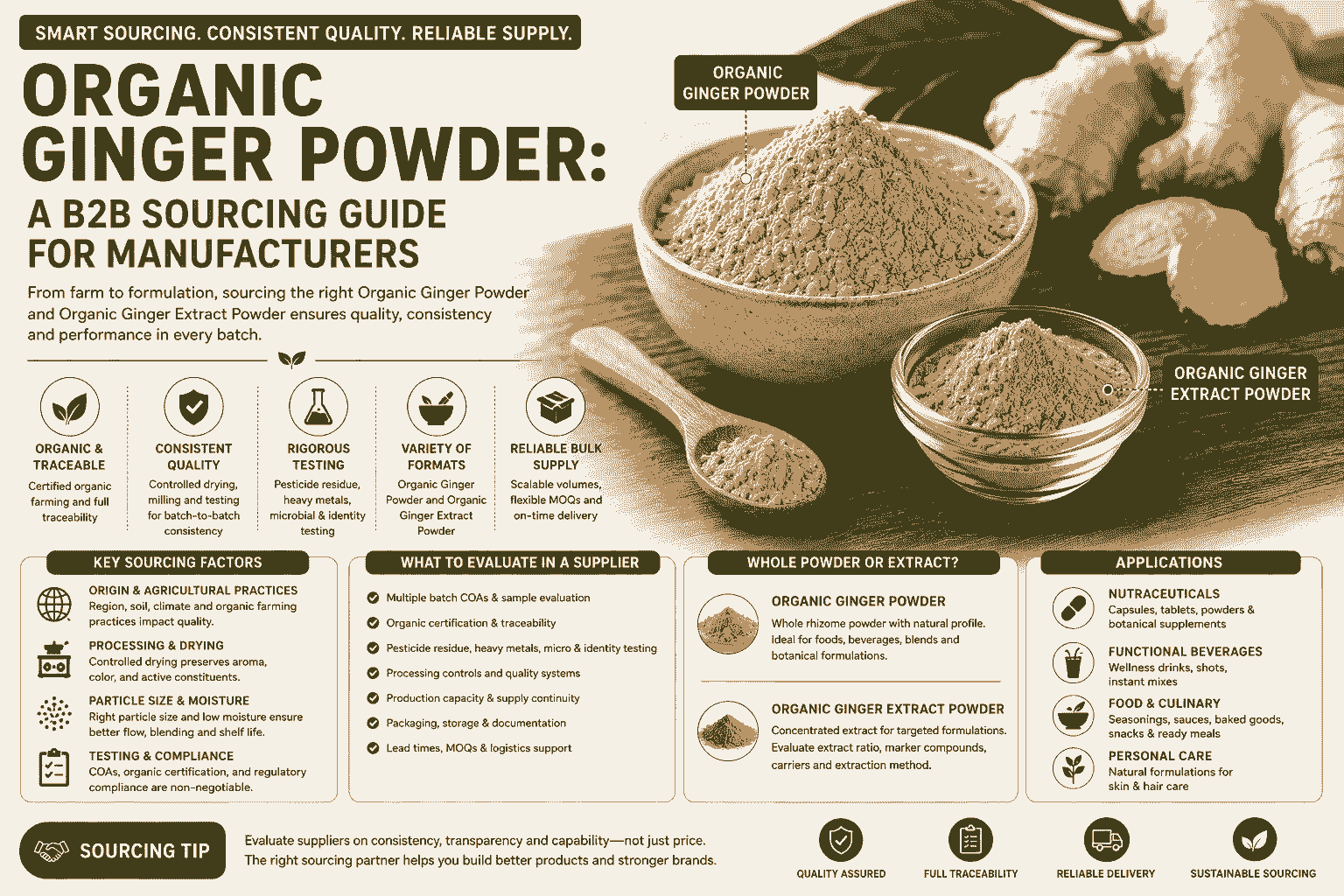
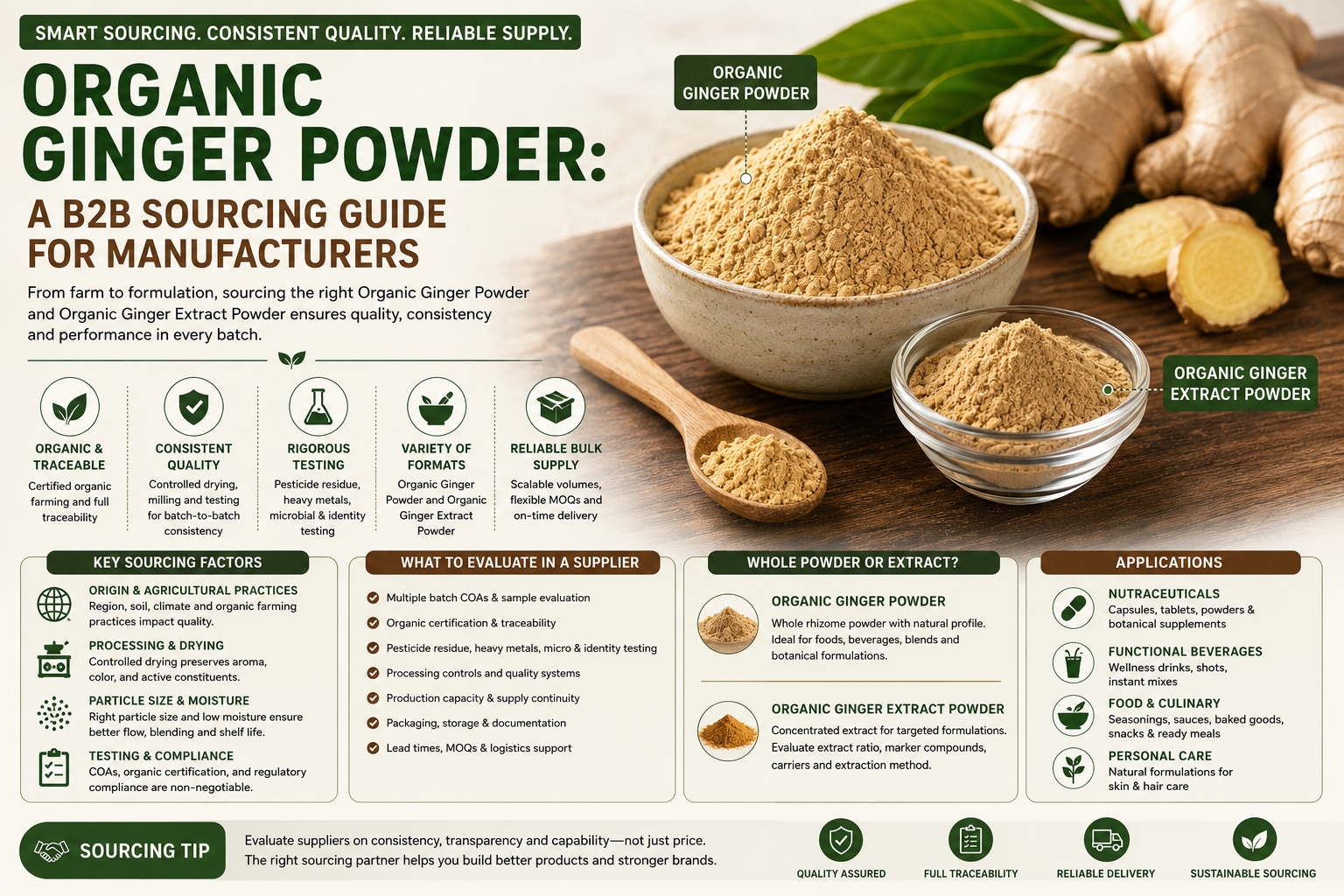
With Organic Ginger Powder, differences in crop origin, ginger maturity, drying conditions, milling, and storage can influence color, aroma, moisture, particle size, and formulation behavior. The same issue becomes even more relevant when comparing whole ginger powder with Organic Ginger Extract Powder, where extraction and concentration methods introduce another layer of specification requirements.
For procurement managers and R&D teams, the practical question is not simply which supplier offers the lowest price. It is whether the ingredient will remain consistent across multiple production lots.
Understanding Organic Ginger Powder in Commercial Supply
Organic Ginger Powder is produced by cleaning, drying, and milling organically cultivated ginger rhizomes, primarily Zingiber officinale. India, China, Peru, and several other producing regions contribute to the global ginger supply, with agricultural conditions and post-harvest practices varying considerably between origins.
After harvesting, ginger may be washed, sliced or prepared for drying, and processed under controlled conditions before milling. Drying temperature is particularly important because excessive heat or inconsistent processing can affect the ingredient’s natural characteristics.
For industrial buyers, important baseline specifications may include moisture, particle size, microbial limits, heavy metals, pesticide residues, identity, and organic status. However, these numbers should be considered alongside physical evaluation of the actual batch.
Why Supplier Qualification Goes Beyond a COA
One sourcing issue we frequently see is treating a Certificate of Analysis as a complete supplier evaluation. A COA confirms whether a particular lot meets stated parameters, but it does not necessarily demonstrate how consistently a supplier can reproduce those results.
Procurement teams should also investigate:
- Country and region of origin
- Harvest and processing practices
- Drying technology
- Milling controls
- Particle size distribution
- Moisture management
- Batch traceability
- Packaging and storage conditions
- Production capacity
- Typical lead times
For organic ingredients, buyers should verify current certification and ensure the certification covers the relevant product and supply chain. Pesticide-residue testing and traceability records can provide additional confidence in agricultural controls.
Formulation Considerations for Ginger Ingredients
From a formulation perspective, Organic Ginger Powder is generally selected when manufacturers want a whole botanical powder that can be incorporated into dry blends, food systems, and powdered beverage formulations.
R&D teams may assess:
- Color and aroma consistency
- Particle size
- Flowability
- Moisture
- Bulk density
- Blend uniformity
- Storage behavior
- Compatibility with other ingredients
Natural variation is expected, but large differences between production lots can create challenges for finished-product consistency, especially where appearance, flavor, or aroma is important.
This is where production-scale testing becomes valuable. A sample may perform well in a laboratory blend but behave differently during high-speed commercial mixing or packaging.
Organic Ginger Powder vs. Organic Ginger Extract Powder
The choice between whole ginger powder and Organic Ginger Extract Powder depends heavily on the formulation objective.
Whole powder is generally appropriate when manufacturers want the broader material profile of the processed ginger rhizome and a less concentrated ingredient format. Extract powder, by contrast, is produced through an extraction and concentration process and may be selected when a formulation requires a more concentrated or controlled ingredient profile.
Procurement teams should therefore avoid comparing the two formats solely by price per kilogram. The relevant comparison is cost-in-use, required inclusion level, specification requirements, and manufacturing performance.
For extract powders, buyers should pay particular attention to extraction method, extract ratio where applicable, carrier materials, solvent information, assay or marker specifications, and documentation supporting the declared composition.
Bulk Sourcing Challenges
Scaling from sample quantities to commercial volumes can expose supply-chain weaknesses. Ginger is an agricultural commodity, so weather, crop yields, regional supply conditions, and harvest timing can influence availability and pricing.
One practical sourcing trigger is repeated variation in color, aroma, moisture, or particle size between batches. These differences should prompt buyers to investigate whether they result from normal agricultural variation or inconsistent processing controls.
Before approving a long-term supplier, procurement teams can request:
- Multiple recent batch COAs
- Representative production samples
- Organic certification
- Pesticide-residue testing
- Heavy metal and microbiological reports
- Identity testing
- Particle size and moisture data
- Traceability information
- Packaging specifications
- Lead-time and supply-continuity information
Evaluating several production lots provides a much clearer picture of consistency than testing a single sample.
Market and Manufacturing Outlook
US manufacturers continue to explore ginger ingredients across botanical supplements, powdered beverages, functional foods, seasoning systems, and combination formulations. This creates opportunities for both whole ginger powders and more concentrated extract formats.
At the same time, procurement teams are placing greater emphasis on traceability, documentation, predictable lead times, and repeatable manufacturing performance. Supplier qualification is becoming less about finding a commodity at the lowest available price and more about controlling raw-material variability.
Conclusion
Sourcing Organic Ginger Powder successfully requires coordination between procurement, quality, and formulation teams. Agricultural origin, drying, milling, moisture, particle size, testing, traceability, and supply continuity can all influence commercial performance.
For manufacturers evaluating Organic Ginger Extract Powder, the assessment should go further by examining extraction methods, concentration, carriers, and relevant marker specifications.
The most reliable sourcing decisions come from combining documentation with physical sample evaluation, production trials, and multiple-batch comparisons. This approach gives manufacturers a clearer view of supplier consistency before an ingredient becomes part of routine commercial production.