
 Written by
 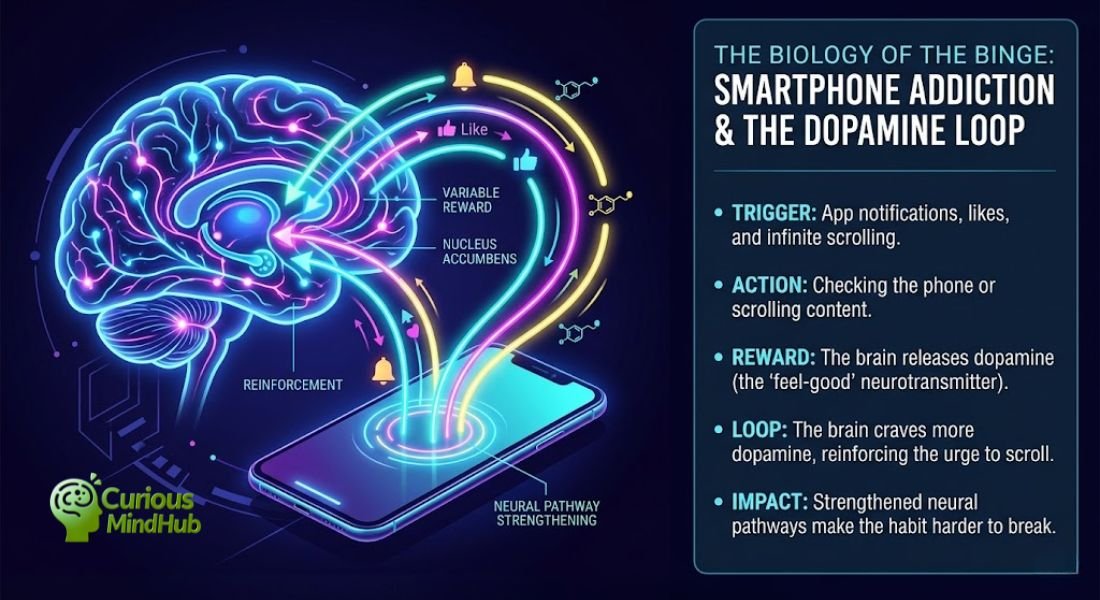 We’ve all been there, right? You grab your phone just to check the weather or one quick text, and then—poof—forty-five minutes are just gone. Vanished. You’re suddenly three miles deep into a stranger’s vacation photos or watching 15-second recipe videos for food you know you’ll never actually cook. It’s incredibly frustrating. You probably feel like you just lack discipline, but honestly? It’s not your fault. Learning how to break a scrolling addiction isn’t about “trying harder.” It’s about outmaneuvering a system that was literally built to keep your thumb moving.
At Curious Mind Hub, we’re big believers that once you understand the “why” behind your habits, you can stop the guilt trip and start getting strategic. This isn’t just a “bad habit”—it’s your ancient brain reacting to a very high-tech trap.
This is How Dopamine Loops Affect the Brain
If you want to beat the scroll, you have to understand dopamine. Most people think it’s a “reward” chemical that makes you feel good. But neuroscientists see it differently. Dopamine is actually about anticipation. It’s the “itch.” It’s what creates that restless drive to check your phone in the first place.
This is basically how dopamine loops affect the brain. Every time you see a red notification or a new post, your brain gets a tiny spike of “what if?” That spike isn’t the pleasure of the content—it’s the craving to find more. Because the internet never “ends,” you stay stuck in a loop of seeking, finding a tiny nugget of info, and immediately hunting for the next one.
The Weird Neurobiology of Infinite Scrolling
Why is it so much harder to put down a phone than a physical book? It’s all in the neurobiology of infinite scrolling. In the real world, we have “stopping cues”—the end of a page, a chapter, or even just reaching the bottom of a newspaper. App developers realized that if they removed those cues, our brains would stay in a state of “flow” that’s actually pretty exhausting for the nervous system.
Without a natural pause, your brain stays on autopilot. You aren’t making a conscious choice to keep looking; you’re just moving through a digital space that has no exits. This friction-less design is exactly what makes a scrolling addiction feel so much more powerful than a normal habit.
Why It Feels Like a Vegas Slot Machine
Ever wonder why you’ll scroll through twenty boring posts just to find one funny meme? That’s the variable reward schedule in social media.
It’s the same trick used in Vegas. If a slot machine paid out every single time you pulled the lever, you’d get bored and walk away. But because the “win” is unpredictable, your brain stays locked in a state of high alert. You keep pulling the digital lever because your brain is convinced the next swipe is going to be the big one.
Rewiring Your Brain for Better Focus
The good news? Your brain is “plastic.” It can heal and change. Rewiring your brain for better focus is mostly about lowering your baseline for stimulation. Right now, your brain is used to high-speed, high-intensity rewards. To fix that, you have to get comfortable with being bored again.
Try Mono-tasking: Just do one thing. If you’re eating dinner, just eat. If you’re watching a movie, leave the phone in a different room.
Embrace the Gap: Next time you’re waiting for coffee, don’t pull out the phone. Just stand there. It’ll feel restless at first—that’s just your dopamine levels recalibrating.
Why Digital Minimalism for Mental Health is the New Essential
We hear a lot about “detoxes,” but those are usually just temporary band-aids. Digital minimalism for mental health is more of a long-term philosophy. It’s not about hating tech; it’s about making sure your tools serve you, not the other way around.
Ask yourself: Does this app actually make my life better, or am I just clicking it because it’s there? When you treat your attention like a limited bank account, you get a lot more protective over who gets to spend it.
Quick Ways to Reduce Social Media Screen Time
If you want to move the needle today, here are some ways to reduce social media screen time that actually work without needing superhero willpower:
Go Greyscale: These apps use bright, “candy-like” colors to trigger your brain. Flip your phone to greyscale in settings. You’ll be shocked at how boring Instagram looks in black and white.
Add Friction: Delete the app and use the mobile browser instead. That extra five seconds of loading and logging in is often enough for your conscious brain to say, “Wait, why am I doing this?”
Human Notifications Only: Turn off every buzz and beep that isn’t from an actual person trying to talk to you. You don’t need a robot telling you to “come back and look at this.”
The Neuroscience of Habit: Why We Slip Up
According to the neuroscience of habit, our brains love shortcuts. A habit is just a loop: a Cue (boredom), a Routine (scrolling), and a Reward (distraction).
To break a social media addiction, you have to interrupt that loop. When you feel that cue of boredom, you need a “replacement habit” ready to go. Maybe it’s taking three deep breaths or just standing up to stretch. It sounds tiny, but it breaks the automatic “boredom-to-phone” pipeline.
The Bottom Line
Taking back your attention is a radical act in 2026. It’s not a straight line, and you’ll have days where you fall back into the rabbit hole. That’s okay. The point is to move from mindless reaction to conscious action.
By understanding the neurobiology of infinite scrolling and the neuroscience of habit, you’re already ahead of the game. You’re no longer just a “user”—you’re an observer. For more on cognitive wellness and living a more intentional life, come visit us at Curious Mind Hub. Our mission at Curious Mind Hub is simple: we want to help you understand your brain so you can live better.
FAQs
Is “scrolling addiction” a real thing?
While “addiction” is a heavy word, we use social media addiction to describe these compulsive cycles. It’s a deep-seated behavioral habit shaped by very smart software. If it’s affecting your focus and making you feel like a zombie, it’s worth taking seriously.
How long does it take to get my focus back?
Most people feel a massive shift after just 48 to 72 hours of intentional boundaries. However, true “rewiring” usually takes about 3 to 4 weeks of consistent effort.
Will I miss out on important stuff?
That’s the FOMO (Fear Of Missing Out) talking. In reality, once you cut the noise, you’ll realize you’re actually engaging more deeply with the stuff that actually matters.
Is it okay to use social media at all?
Definitely! Social media is a tool for connection. The goal is to use it with intention rather than just out of compulsion.