Written by
Jewelry Market to Reach USD 458.70 Billion by 2034, Driven by Rising Luxury Spending, Personalization, and Sustainable Jewelry Trends
1. Jewelry Market Estimation, Growth Drivers, and Opportunities
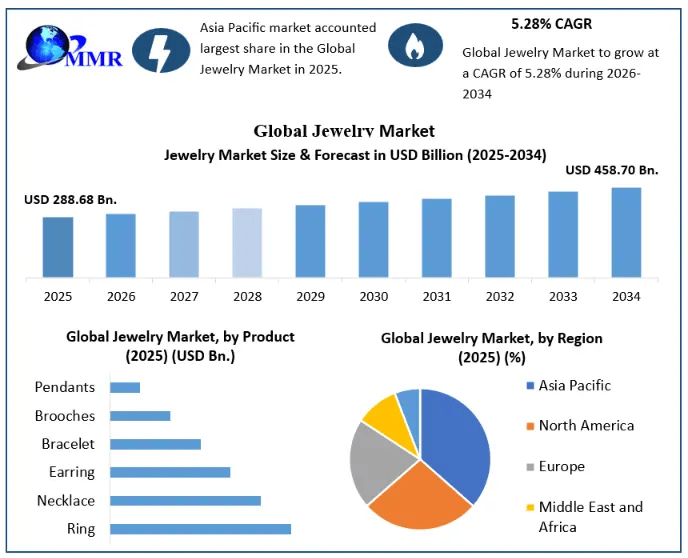
The global Jewelry Market was valued at USD 288.68 billion in 2025 and is projected to reach USD 458.70 billion by 2034, registering a CAGR of 5.28% during the forecast period of 2026–2034. The market is experiencing steady expansion as consumers increasingly consider jewelry an expression of personal identity, fashion, cultural heritage, and financial value. Growing disposable incomes, rising demand for luxury accessories, increasing wedding and engagement expenditure, and expanding branded jewelry retail networks are supporting industry growth. Gold and diamond jewelry continue to attract consumers because of their traditional significance, premium appeal, and perceived long-term value.
Changing fashion preferences and increasing interest in personalized products are creating additional growth opportunities. Consumers, particularly Millennials and Generation Z, are showing greater interest in customized rings, gemstone necklaces, minimalist designs, and contemporary jewelry collections. Manufacturers are adopting computer-aided design (CAD), 3D printing, artificial intelligence, and advanced manufacturing technologies to develop intricate designs while improving production efficiency. Furthermore, the expansion of e-commerce, augmented reality (AR) virtual try-on applications, and direct-to-consumer retail models is improving accessibility and customer engagement. Growing demand for ethically sourced gemstones, recycled precious metals, and lab-grown diamonds is also encouraging manufacturers to introduce sustainable product collections. These developments are expected to create attractive investment opportunities across premium jewelry, affordable luxury, customized products, and digital retail channels.
To know the most attractive segments, click here for a free sample of the report: https://www.maximizemarketresearch.com/market-report/jewelry-market/147820/
2. US Jewelry Market: Latest Trends and Investments in 2024
The United States remains one of the most influential jewelry markets, supported by strong consumer purchasing power, established luxury retail networks, and increasing demand for personalized and contemporary jewelry. In 2024, yellow gold jewelry, stackable bracelets, tennis bracelets, mixed-shaped diamond designs, and bridal jewelry gained consumer attention. Younger buyers increasingly explored distinctive designs, while traditional diamond jewelry continued to maintain its importance in engagement and gifting purchases. The US jewelry industry also experienced increasing interest in lab-grown diamonds because of their affordability and accessibility. According to 2024 market performance data published in January 2025, total US jewelry sales increased by 1.4% in 2024, while lab-grown diamonds accounted for approximately 14% of the market. Retailers continued to focus on inventory management, premium product offerings, and digital shopping experiences. Investment opportunities are particularly attractive in sustainable jewelry manufacturing, laboratory-grown gemstones, omnichannel retailing, and customized luxury collections.
3. Jewelry Market Segmentation: Largest Market Share
Based on product, the Ring segment held the leading position in the global jewelry market in 2025. Its dominance is primarily supported by consistent demand for engagement rings, wedding bands, diamond rings, and premium fashion accessories. Rings remain an important category for wedding ceremonies, anniversaries, gifting, and personal expression. Increasing demand for customized engagement rings, gender-neutral designs, and gemstone-studded fashion rings is further strengthening this segment.
Based on material, Gold accounted for a significant market share. Its leadership is supported by strong cultural and traditional demand, particularly in Asian countries, where gold jewelry is widely purchased for weddings, festivals, and other celebrations. Gold also attracts consumers as a store of value and an investment-oriented purchase. The increasing availability of lightweight gold ornaments, contemporary designs, and premium gold collections is further supporting the segment’s growth.
4. Jewelry Market Competitive Analysis
The global jewelry market features established luxury brands competing through product innovation, craftsmanship, brand recognition, exclusive collections, and international retail expansion. The five leading companies highlighted among the key players in the market report include:
1. Tiffany & Co.: Tiffany & Co. maintains a strong position in the global luxury jewelry industry through its diamond collections, premium craftsmanship, and distinctive brand identity. In 2024, the company strengthened its sustainability strategy through responsible material sourcing and diamond traceability initiatives. Its 2024 sustainability report highlighted 99.99% traceability of newly sourced, individually registered diamonds to their mine of origin or approved mines. The company also introduced its Love For Our Oceans initiative, incorporating ocean-bound recycled plastic into bracelet cords and committing at least USD 1 million to ocean conservation. These initiatives strengthen consumer confidence and support the growing demand for responsible luxury jewelry.
2. Bvlgari: Bvlgari continues to strengthen its competitive position through innovative designs, premium gemstones, and contemporary luxury collections. In April 2024, the company introduced Bulgari Studio, a creative platform focused on collaboration, experimentation, and innovative design. The initiative reimagined its iconic B.zero1 collection through collaborations with contemporary creative talents. This approach supports product differentiation, attracts younger luxury consumers, and creates opportunities for new jewelry designs.
3. Van Cleef & Arpels: Van Cleef & Arpels maintains its reputation through exceptional craftsmanship, intricate gemstone settings, and exclusive high-jewelry collections. Its patented Mystery Set technique remains an important example of technical innovation, allowing gemstones to be positioned with minimal visible metal. Continued investment in skilled artisans, precision stone-setting, and traditional manufacturing expertise supports the company’s premium positioning and encourages demand for exclusive jewelry.
4. Harry Winston: Harry Winston differentiates itself through exceptional diamonds, rare gemstones, and handcrafted high-jewelry collections. The company combines traditional craftsmanship with modern manufacturing techniques through its specialized jewelry workshops in New York. In 2024, its Majestic Escapes high-jewelry collection showcased elaborate gemstone designs inspired by natural landscapes and destinations. Such exclusive collections reinforce the brand’s luxury appeal and encourage demand for high-value diamond jewelry.
5. Piaget: Piaget continues to expand its presence in the luxury jewelry segment through innovative gold craftsmanship, gemstone combinations, and artistic designs. In June 2024, the company celebrated its 150th anniversary with a high-jewelry collection featuring approximately 100 distinctive creations. The collection highlighted colorful gemstones, gold craftsmanship, necklaces, and fluid cuff bracelets. Its focus on combining traditional techniques with contemporary aesthetics strengthens its product differentiation and supports growth in premium jewelry demand.
5. Jewelry Market Regional Analysis: USA, UK, Germany, France, Japan, and China
United States: The US is an important global jewelry market, supported by high consumer purchasing power, established luxury brands, and strong demand for diamond and gold jewelry. The market benefits from the Federal Trade Commission’s Jewelry Guides, which provide guidelines against misleading claims about precious metals, gemstones, and jewelry quality. Increasing demand for personalized engagement rings, lab-grown diamonds, and sustainable luxury products is creating further opportunities.
United Kingdom: The UK jewelry market benefits from a well-established luxury retail sector, strong consumer demand for precious metals, and a recognized hallmarking system. Under the Hallmarking Act 1973, qualifying gold, silver, platinum, and palladium articles must carry legally recognized hallmarks. This framework protects consumers by verifying precious-metal purity and supports confidence in jewelry purchases. Demand for branded luxury products, designer collections, and personalized jewelry further contributes to market development.
Germany: Germany represents an important European market for premium jewelry, supported by strong purchasing power, established manufacturing capabilities, and demand for quality-oriented products. Its regulatory framework does not generally require hallmarking as a pre-market authorization. The country’s established luxury retail infrastructure and consumer preference for durable, high-quality products provide opportunities for international jewelry manufacturers.
France: France is a significant luxury jewelry destination, benefiting from internationally recognized fashion houses, established jewelry craftsmanship, and premium consumer demand. Hallmarking is legally required, and importers must register with the relevant guarantee offices. The country’s luxury manufacturing ecosystem, established designer brands, and international tourism support demand for exclusive jewelry, precious gemstones, and high-end collections.
Japan: Japan’s jewelry market is supported by sophisticated consumer preferences, established retail infrastructure, and demand for premium craftsmanship. Consumers show interest in high-quality gold, platinum, pearls, and diamond jewelry. Precious-metal hallmarking is voluntary, with third-party certification available through official testing institutions. The country’s strong emphasis on product quality, craftsmanship, and authenticity creates opportunities for premium jewelry manufacturers.
China: China represents one of the most important jewelry markets globally, supported by strong cultural demand for gold ornaments, rising luxury consumption, and expanding digital retail channels. Gold jewelry remains particularly significant because of its association with prosperity, weddings, gifting, and wealth preservation. The country’s national precious-metal standards and quality-control framework support product authentication and consumer protection. In 2024, China’s gold jewelry consumption reached approximately 479.3 tonnes, compared with 630.2 tonnes in 2023, reflecting the impact of elevated gold prices and weaker consumer demand. Nevertheless, demand for innovative gold designs, lightweight jewelry, and fashionable collections provides opportunities for manufacturers.
The market report identifies Asia Pacific as the leading regional market, accounting for nearly 60% of global jewelry demand. However, it does not provide independently verified global market-share percentages for each of the six countries discussed above. Therefore, individual country shares have not been estimated.
6. Conclusion
The global jewelry market is expected to maintain steady growth through 2034, supported by increasing luxury expenditure, rising disposable incomes, changing fashion preferences, and expanding demand for personalized jewelry. Gold and diamond products will continue to play important roles because of their traditional significance, premium positioning, and consumer appeal. At the same time, technological advancements, digital retailing, and sustainable manufacturing practices are transforming the competitive landscape.
In my view, the most significant growth opportunity will emerge from the combination of personalization, sustainable materials, and digital shopping experiences. Manufacturers investing in lab-grown diamonds, recycled precious metals, AI-assisted jewelry design, and customized collections will be better positioned to attract younger consumers and expand their customer base. Furthermore, expanding online distribution networks and strengthening product traceability can improve consumer trust and international competitiveness. Companies that successfully combine traditional craftsmanship with modern technology, responsible sourcing, and innovative designs are likely to gain a competitive advantage in the evolving global jewelry industry.
To know the most attractive segments, click here for a free sample of the report: https://www.maximizemarketresearch.com/request-sample/147820/
About us
Maximize Market Research publishes sector forecasts, competitive analysis, and consulting insight for teams evaluating demand, competition, pricing, and growth strategy across high-value industries.
MAXIMIZE MARKET RESEARCH PVT. LTD.
2nd Floor, Navale IT Park Phase 3
Pune Banglore Highway, Narhe
Pune, Maharashtra 411041, India
+91 9607365656
sales@maximizemarketresearch.com