Written by
Product Engineering Services Market to Reach USD 1,972.39 Billion by 2032, Driven by AI Integration, Digital Transformation, and Smart Product Development
1. Product Engineering Services Market Estimation, Growth Drivers, and Opportunities
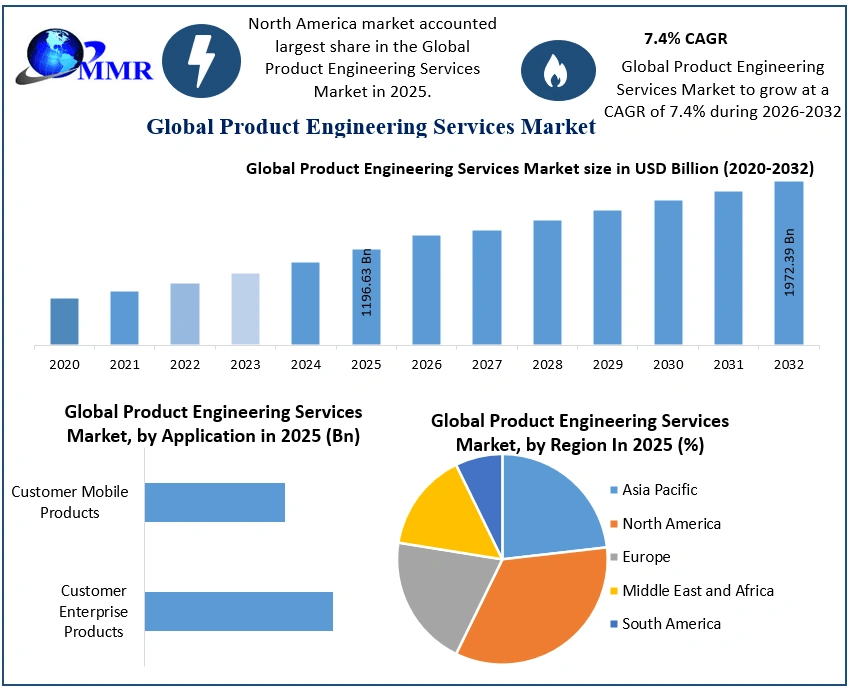
The global Product Engineering Services Market was valued at USD 1,196.63 billion in 2025 and is projected to reach USD 1,972.39 billion by 2032, growing at a CAGR of 7.4% during the forecast period from 2026 to 2032. The market is witnessing strong growth as businesses increasingly adopt advanced engineering solutions to accelerate product development, improve operational efficiency, and reduce time-to-market. Growing demand for connected devices, smart electronics, industrial automation, and intelligent automotive systems is encouraging organizations to invest in specialized product engineering services. Companies across automotive, healthcare, aerospace, telecommunications, and industrial manufacturing are increasingly outsourcing engineering activities to access technical expertise, reduce development costs, and improve product quality.
The growing adoption of artificial intelligence (AI), machine learning (ML), cloud computing, Internet of Things (IoT), and digital twin technologies is further supporting market expansion. These technologies enable businesses to improve product design, automate engineering workflows, conduct virtual testing, and optimize manufacturing processes. Increasing product complexity and the need for continuous innovation are also encouraging companies to collaborate with engineering service providers throughout the product development lifecycle. Furthermore, software-defined products, connected mobility solutions, advanced semiconductor systems, and smart manufacturing technologies are generating additional demand for engineering expertise.
The market also offers significant opportunities through the integration of generative AI, predictive analytics, automation, and sustainable engineering practices. AI-powered design tools can accelerate product development, improve testing accuracy, and reduce engineering costs. Digital twins and simulation technologies allow manufacturers to evaluate product performance before physical production, minimizing development risks and material waste. Additionally, increasing investments in electric vehicles, autonomous systems, medical devices, and next-generation communication technologies are expected to create attractive opportunities for service providers. Companies focusing on AI-enabled engineering, embedded software, cloud-native product development, and cybersecurity are likely to benefit from the growing demand for advanced product engineering solutions.
To know the most attractive segments, click here for a free sample of the report: https://www.maximizemarketresearch.com/market-report/product-engineering-services-market/122268/
2. US Product Engineering Services Market: Latest Trends and Investments in 2024
The US product engineering services market maintained strong momentum in 2024, driven by growing investments in semiconductor technologies, artificial intelligence, advanced electronics, aerospace, and automotive innovation. Companies increasingly adopted digital engineering, software development, connected product solutions, and automation to enhance product quality, streamline operations, and shorten development cycles. The continued implementation of the CHIPS and Science Act was a significant development, as the US government focused on expanding domestic semiconductor manufacturing and strengthening research and development capabilities. In February 2024, the Biden administration announced more than USD 5 billion in anticipated investments for semiconductor R&D, including support for the National Semiconductor Technology Center. Another important initiative came in October 2024, when the US Treasury Department and the Internal Revenue Service issued final regulations for the Advanced Manufacturing Investment Credit to encourage domestic semiconductor production and investments in manufacturing equipment. These measures strengthened demand for specialized engineering services, particularly in chip design, hardware development, embedded systems, product testing, and advanced manufacturing. At the same time, businesses accelerated the adoption of generative AI and digital product development tools to improve engineering efficiency, optimize design processes, and bring innovative products to market faster.
3. Product Engineering Services Market Segmentation: Key Segments
The Product Engineering Services Market is segmented by type of services, industry, application, and organization size. The report identifies software engineering, hardware engineering, process engineering, and other services as the major service categories. However, its publicly available summary does not disclose the individual market-share percentages or conclusively identify the largest segment in each category. Therefore, an unsupported segment leader or market-share figure has not been assigned.
The major industry segments include BFSI, IT and telecommunications, automotive, industrial manufacturing, energy and utilities, healthcare, and aerospace and defense. Applications are categorized into customer enterprise products and customer mobile products, while organization size includes large enterprises and SMEs. Demand across these categories is supported by increasing requirements for connected products, software modernization, automated manufacturing, and advanced digital solutions. Large organizations and technology-intensive industries represent important customer groups because of their extensive product development requirements and continuous investment in innovation.
4. Product Engineering Services Market Competitive Analysis
The global product engineering services industry is characterized by strong competition among technology consulting companies, engineering specialists, and digital transformation providers. Leading players are focusing on AI integration, research and development, engineering automation, cloud platforms, and strategic acquisitions to strengthen their service portfolios. Five prominent companies identified in the market report include:
1. IBM Corporation: IBM maintains a strong position through its expertise in software engineering, hybrid cloud, artificial intelligence, and enterprise technology solutions. In 2024, the company continued increasing investments in AI and advanced computing capabilities. IBM’s research, development, and engineering expenditure reached approximately USD 7.48 billion in 2024, representing a 10.4% increase compared with 2023. Its investments focused on generative AI, hybrid cloud, quantum computing, and infrastructure innovation. These developments support the integration of intelligent technologies into product development, engineering automation, and enterprise solutions.
2. Capgemini: Capgemini strengthens its competitive position through digital engineering, product lifecycle management, cloud technologies, and advanced research and development services. In October 2024, the company introduced new generative AI-powered augmented engineering offerings designed to accelerate product innovation and improve engineering workflows. These solutions help businesses automate engineering activities, optimize research processes, and enhance product development throughout the lifecycle. Capgemini also continued investing in engineering capabilities covering IoT, augmented reality, virtual reality, computer-aided design, and simulation technologies.
3. ALTEN Group: ALTEN Group is a prominent engineering and technology consulting company providing product development, digital engineering, and research services across automotive, aerospace, telecommunications, and industrial sectors. In 2024, the company strengthened its international operations through acquisitions, including a software development business in Asia and an IT services company in Poland. It also finalized the acquisition of Worldgrid, a European specialist in energy and utility solutions, in November 2024. These strategic developments expanded its engineering expertise and strengthened its capabilities in software development, energy systems, and industrial digitalization.
4. HCLTech: HCLTech continues to expand its engineering and research capabilities through investments in artificial intelligence, embedded systems, digital twins, semiconductor engineering, and connected products. In March 2024, the company launched HCLTech AI Force, a generative AI platform designed to improve software development and engineering lifecycle productivity. Built on Azure OpenAI, the platform supports automation across engineering workflows, improves software quality, and accelerates release timelines. The company’s continued investment in GenAI laboratories, digital engineering, and cloud-based development solutions strengthens its position in the global product engineering services market.
5. Accenture: Accenture maintains a strong competitive presence through engineering consulting, digital transformation, cloud computing, and advanced technology services. In fiscal 2024, the company invested approximately USD 6.6 billion across 46 strategic acquisitions and USD 1.2 billion in research and development. Its acquisition strategy focused on expanding capabilities in digital engineering, IoT, connected products, automation, and generative AI. Investments in engineering technologies and intelligent product development enable Accenture to help businesses modernize operations, improve product performance, and accelerate innovation.
5. Product Engineering Services Market Regional Analysis: USA, UK, Germany, France, Japan, and China
United States: The United States is a major market for product engineering services, supported by advanced technological infrastructure, strong research and development investments, and the presence of leading technology companies. Demand is increasing across semiconductor engineering, aerospace, automotive, healthcare, and industrial automation. Government initiatives under the CHIPS and Science Act encourage domestic semiconductor manufacturing, research, and advanced technology development. The country’s strong innovation ecosystem, skilled engineering workforce, and investments in AI, cloud computing, and connected products provide significant growth opportunities.
United Kingdom: The UK product engineering services market benefits from its established technology sector, semiconductor research capabilities, and growing investments in digital transformation. The government’s National Semiconductor Strategy aims to strengthen domestic chip design, research, and manufacturing capabilities through investment of up to GBP 1 billion over a decade. The strategy also supports research infrastructure, specialized engineering skills, and collaboration between industry and academic institutions. Increasing demand for advanced electronics, AI, automotive technologies, and software engineering is supporting market development.
Germany: Germany represents an important European market for product engineering services, supported by its strong automotive industry, industrial manufacturing capabilities, and engineering expertise. Demand for electric vehicles, autonomous driving technologies, industrial robotics, and smart manufacturing is encouraging companies to adopt advanced engineering solutions. The European Chips Act provides additional support for semiconductor research, innovation, manufacturing, and supply-chain resilience. Germany’s established automotive ecosystem and Industry 4.0 initiatives create opportunities for engineering service providers specializing in embedded systems, digital twins, and automation.
France: France is an important market for product engineering services because of its aerospace, automotive, defense, energy, and technology industries. The country benefits from established research institutions, engineering talent, and government-supported innovation programmes. The European Chips Act supports semiconductor research, advanced chip design, and manufacturing innovation across France and other EU member states. Growing investments in aerospace modernization, electric mobility, digital infrastructure, and industrial automation are further increasing demand for specialized engineering services.
Japan: Japan’s product engineering services market is supported by advanced manufacturing capabilities, automotive innovation, robotics, and electronics development. The government’s Society 5.0 initiative promotes the integration of digital technologies, artificial intelligence, IoT, and physical infrastructure to create intelligent industrial and social systems. In June 2024, Japan’s Ministry of Economy, Trade and Industry introduced the Smart Manufacturing Development Guideline to help manufacturers adopt digital solutions and improve operational efficiency. Additionally, the Mobility DX Strategy announced in May 2024 promotes software-defined vehicles and digital transformation in the automotive industry, creating opportunities for embedded software, connected mobility, and automotive engineering services.
China: China represents a significant market for product engineering services, supported by its large manufacturing base, expanding technology industry, and increasing adoption of industrial automation. Government initiatives focus on developing advanced manufacturing, artificial intelligence, robotics, industrial internet, and next-generation technologies. In January 2024, China’s Ministry of Industry and Information Technology and other government departments introduced measures to accelerate innovation in future industries, including intelligent manufacturing, advanced materials, and next-generation information technologies. Additionally, the country’s manufacturing modernization programmes encourage businesses to adopt digital engineering, smart production systems, and automated product development processes.
Regional Market Overview: North America held the leading position in the global product engineering services market, supported by advanced technological infrastructure, substantial research and development expenditure, and the presence of major engineering and IT service providers. The United States contributes significantly to regional demand through investments in semiconductor technologies, aerospace, automotive innovation, healthcare technologies, and digital transformation. The report identifies North America as the largest regional market but does not disclose a verified percentage share for the region or individual countries in its publicly available summary. Therefore, specific country-level global market shares have not been estimated.
6. Conclusion
The global product engineering services market is expected to maintain strong growth through 2032, driven by increasing demand for advanced product development, digital transformation, connected technologies, and engineering automation. Artificial intelligence, machine learning, cloud computing, digital twins, and IoT are transforming traditional engineering processes and helping businesses improve product quality while reducing development costs and time-to-market.
In my view, AI-powered engineering and smart product development will be among the most influential growth opportunities over the coming years. Companies investing in generative AI, semiconductor design, embedded software, digital twin technology, and automated testing will have significant opportunities to strengthen their market positions. Furthermore, growing investments in electric vehicles, autonomous systems, smart manufacturing, aerospace technologies, and advanced medical devices will generate additional demand for specialized engineering services. Strategic partnerships, research and development investments, and access to skilled engineering professionals will also remain essential for long-term competitiveness. Service providers that combine technological innovation, cost-effective solutions, engineering expertise, and scalable digital platforms are likely to benefit substantially from the expanding global product engineering services industry.
To know the most attractive segments, click here for a free sample of the report: https://www.maximizemarketresearch.com/request-sample/122268/
About us
Maximize Market Research publishes sector forecasts, competitive analysis, and consulting insight for teams evaluating demand, competition, pricing, and growth strategy across high-value industries.
MAXIMIZE MARKET RESEARCH PVT. LTD.
2nd Floor, Navale IT Park Phase 3
Pune Banglore Highway, Narhe
Pune, Maharashtra 411041, India
+91 9607365656
sales@maximizemarketresearch.com